
Coastal and maritime tourism is the largest sector of the EU Blue Economy in terms of GVA and employment, with EU coastal areas being highly sought-after destinations for both European and international travellers. Over half of the EU bed capacity is located in regions with a sea border1.
Tourism plays a significant role in the economies of many non-landlocked EU Member States, particularly in Southern Europe, where it contributes a substantial portion of their total national revenue2.
At the same time, coastal regions are those with the highest seasonality, i.e., with tourism demand concentrated in a limited number of months, usually July and August3.
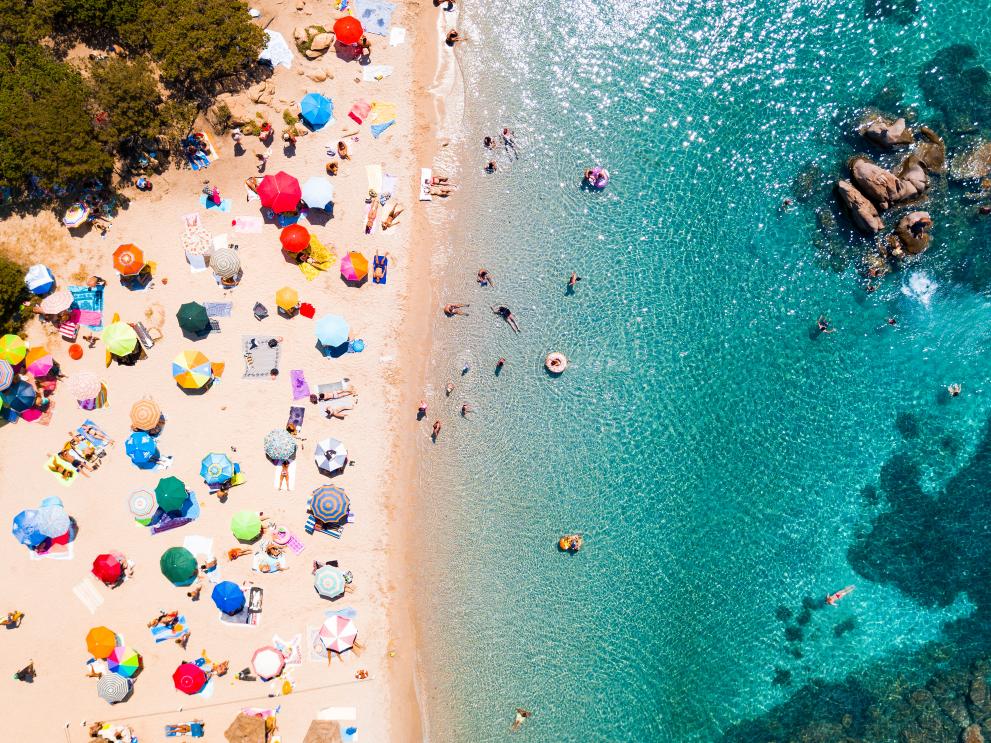
The Coastal tourism sector comprises recreational activities in the proximity of the sea (e.g. beach-based tourism, coastal walks, wildlife watching) as well as those in the maritime area, including nautical sports (e.g. sailing, scuba diving, cruising, etc.). The socio-economic statistics presented in this section originate from three typologies of activities typically undertaken by tourists as reported by EU Member States, attributed to coastal areas on the basis of a specific computation methodology:
- Accommodation, i.e. nights spent at tourist accommodation establishments in coastal areas;
- Transport, reflecting the maritime proportion of sea-borne, road, rail and air passenger travel;
- Other expenditures, covering specific tourist expenditures in coastal areas (e.g., food & beverage services, cultural and recreational goods, purchase of water-sport equipment and clothing, etc.).
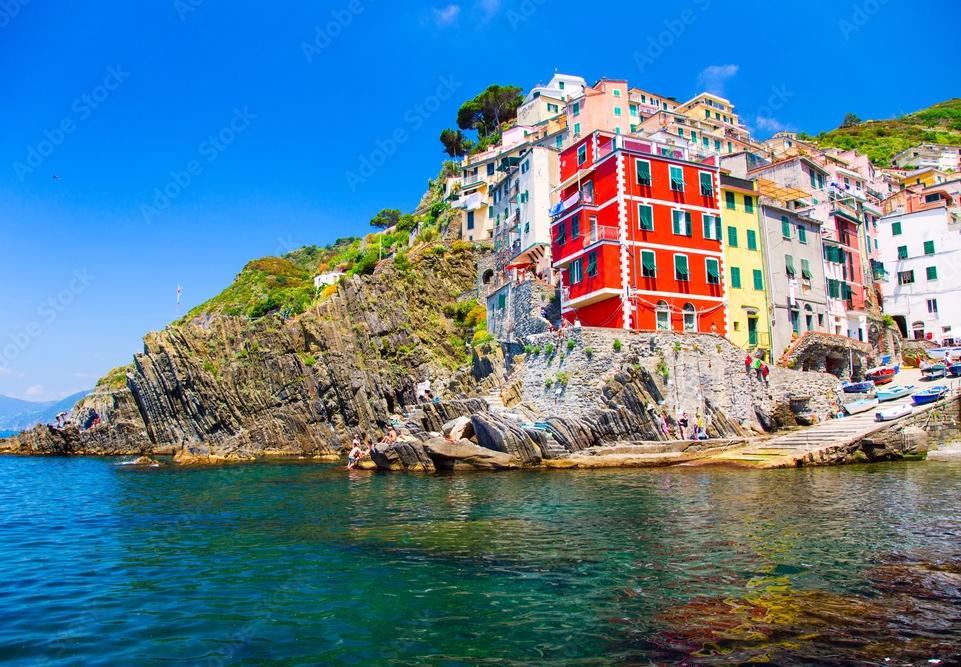
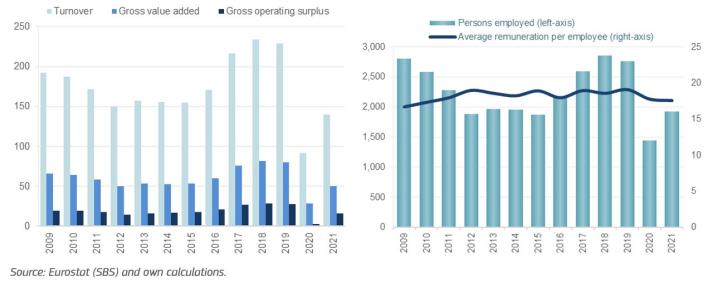
The sector was hit hard by the COVID-19 pandemic in 2020. In 2021, the coastal tourism sector recovered, but still did not reach the pre-crisis level. The GVA generated by the sector amounted to €49.9 billion, up from €28.6 billion registered in 2020, i.e., a year-on-year 74% increase, but still a 38%-contraction compared to 2019. Gross profits, at €16.1 billion, increased 4.2 times compared to 2020. Nonetheless, the sector’s turnover resulting from the aggregation of the abovementioned sub-sectors amounted to €140.0 billion (Figure 2.14).
Text description of images at the bottom of the page
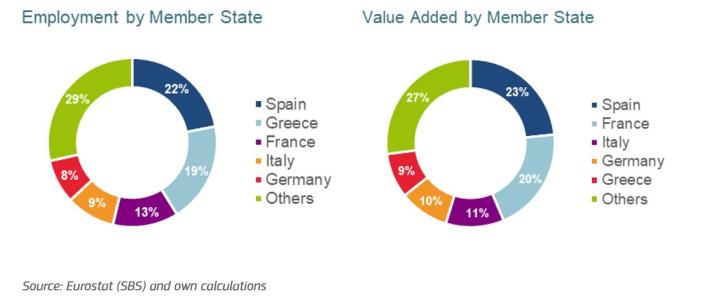
In 2021, Spain led the Coastal tourism sector in terms of employment contributing 22% of jobs, followed by Greece with 19%, France with 13% and Italy with 9%. The sub-sector Accommodation employed almost 848 000 persons, accounting for about 44% of the jobs, while about 812 000 persons (42%) were employed in Other services (e.g. restaurants), and about 263 000 persons (14%) were employed in Transport.
In terms of GVA, Spain led with 23%, France with 20%, and Italy with 11% in 2021. The sub-sector Accommodation generated €24 billion in GVA, about 48% of the sector’s GVA, while other services generated €16.7 million (34%) and Transport €9.1 million (18%).
![[Bathing boxes on the beach]](https://blue-economy-observatory.ec.europa.eu/sites/default/files/styles/oe_theme_medium_no_crop/public/2022-04/AdobeStock_5838556.jpeg?itok=l8qZLy3o)
Coastal tourism was hit hard by the Covid-19 pandemic and is taking longer than other blue economy sectors to recover. The overall tourism sector was hit hard by the pandemic in 2020, even if coastal tourism was the least affected typology. Controlling for restrictions, the loss in guest nights in 2020 compared to 2019 was relatively higher in urban and rural destinations, indicating higher preferences from tourists for coastal destinations4.
The first priority area of the “Coastal and Maritime Strategy” of 2014 highlights “opportunities for cruise tourism” in a sustainable manner.
According to industry representatives, the cruise sector represented 1.2 million jobs and contributed $150 billion to the global economy before the Covid-19 pandemic. With around sixty ports suitable for cruise ships, Europe ranks second behind the American continent.
It has a notable effect on regions and countries with cruise ports, contributing to job creation, port infrastructure development, and the stimulation of local economies. However, cruise tourism also encounters substantial criticism for its significant impacts, particularly concerning pollution, carbon footprint, etc.5
Measuring the exact economic impact of this type of tourism on the local economy can be challenging due to the lack of overnight stays, which sets it apart from other forms of tourism. Tourists typically visit for the day, participating in activities such as shopping and dining. To accommodate the arrival of hundreds or even thousands of tourists, host cities need to have robust infrastructure, logistics, transportation, and services in place.

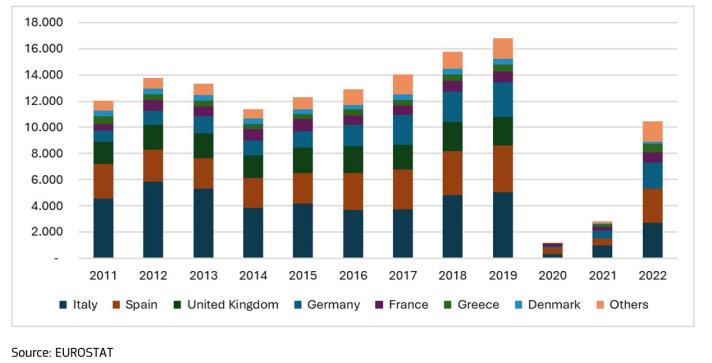
The Eurostat dataset6includes data on cruise passengers, including both those making stopovers and those starting or ending their cruise. However, this study does not consider expenses in the embarkation port such as hotel accommodations, restaurants (however it might be considered in standard coastal tourism economic impact assessment based on overnight stays). The graph below illustrates the volume of tourists (in thousands) disembarking during their cruises in European countries.
Throughout the 2010s, the cruise tourism industry experienced rapid growth from 12 to 17 million passengers disembarking in EU ports, offering an expanding array of itineraries, varying lengths of stay, and diverse ports of call. Italy and Spain emerged as the top two European countries hosting the highest number of cruise passengers. Together they represented half of all European cruise passengers in 2019, i.e., over 8 million people.
However, the onset of the COVID-19 pandemic halted cruise operations for over 4 months, with a slow recovery due to strict restrictions. There has therefore been an exceptional 16-fold reduction in stopover passengers between 2019 and 2020.
During this period, the sector utilised the pause to rebuild and construct ships with greater environmental sustainability and increased capacity. Since then, the industry has largely resumed its operations, returning progressively to pre-pandemic levels.
Eurostat also provides a breakdown of cruise passengers by port, allowing them to group them by seaboards. Certain countries, like Italy and Spain, have ports hosting cruise ships on two seaboards. In 2022, the most important seaboard in the EU-27 in terms of number of cruise passengers was Western Mediterranean (almost half of the EU total with Barcelona, Palma de Mallorca and Civitavecchia as main ports), followed by Northern Europe (with Antwerp-Bruges and Hamburg being the main ports) and Scandinavia/Baltic (Kiel being the main port).
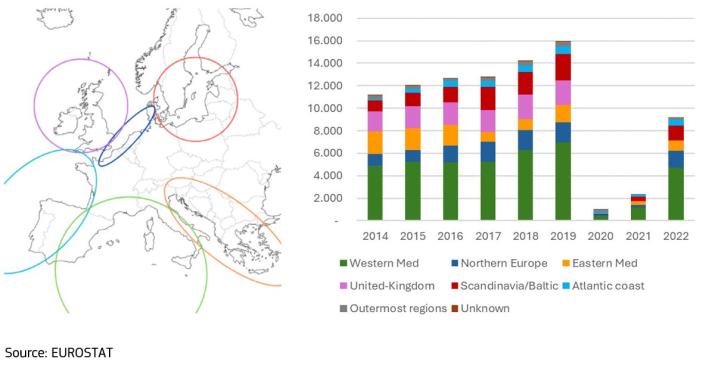
*Fig. 3: This method leads to a sum of visitors per country slightly lower than the figures obtained in the database by country but the breakdowns by seaboards are comparable.
Hosting countries can receive economic benefits from cruise tourism:
- Revenue from passengers’ expenditure: Cruise tourists typically spend money on various goods and services such as shopping, dining, tours, and transportation, directly benefiting local businesses and contributing to the economy.
- Port Fees and Taxes: Cruise lines pay fees to dock their ships at ports, and passengers may incur local taxes or tariffs, contributing to the revenue of port authorities and local governments.
- Job Creation: Cruise tourism creates employment opportunities in sectors like hospitality, retail, transportation, and entertainment, providing jobs for local residents.
- Infrastructure Development: Ports may invest in infrastructure improvements to accommodate cruise ships, leading to long-term economic benefits by enhancing port capacity and attracting additional tourism-related businesses.
- Multiplier Effect: Cruise tourism generates indirect effects through supply chain linkages and multiplier effects, stimulating economic activity and job creation beyond direct passenger spending.
Overall, cruise tourism can be a significant driver of economic growth and development for host countries, particularly those with attractive port destinations and supportive infrastructure.
Despite the economic benefits that cruise tourism offers, it is also subject to criticism and various challenges. Some of the main criticisms and challenges associated with the cruise industry include: air and water pollutions, waste management, overcrowding in port cities, regulatory challenges due to the specific status of the cruise industry, etc.
The average expenditure of cruise passengers in ports varies significantly based on factors such as destination, cruise line, duration of the cruise, demographics, and individual spending habits. Research from Cruise Lines International Association (CLIA) indicates that, in Europe, expenditure varies with a range of €50 to €150 per day per passenger. These figures are approximate and can differ based on the port, itinerary, and passenger preferences.
Cruise lines and port authorities often analyse spending patterns to tailor offerings and improve the overall passenger experience in each region. Based on a literature review, the amount of money spent by cruise passengers during their stopovers varies between €30 and €70 on average in Europe. Among these sources, no significant differences are observed across EU seaboards as variations of expenses depend on other drivers.
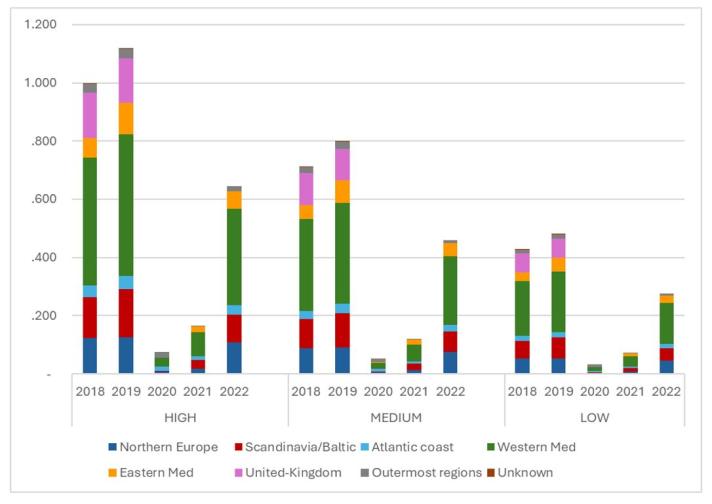
Then, by multiplying this individual expenditure with Eurostat data by seaboards, we estimated the contribution of cruise tourists' spending to the EU local economies. We based our estimates on 3 scenarios of average expenditure:
- “high”: €70
- “medium”: €50
- “low”: €30
In 2022, the sum of cruise passengers’ expenditure in Europe ranges between €276 and €644 million according to the calculations. Before COVID-19 it was between €465 million and €1 billion. For EU-27 only, the total amounted to €274 and €644 million in 2022. These estimates are much lower than the estimates of the Cruise Lines International Association that consider a €44 billion economic contribution and 315 000 jobs provided by the industry in Europe in 20217. This highlights that cruise passengers onshore expenditures may only represent a limited share of the economic contribution of the sector.
While recovering from the Covid-19 pandemic, the Coastal tourism sector has engaged in the sustainability transition with the aim to green its operations, reduce its negative impacts on the marine environment, and strengthen its resilience to exogenous shocks such as commodity and fuel price inflation.
For this purpose, the European Commission has published the Tourism Transition Pathway involving all tourism stakeholders. The updated Industrial Strategy (2021) calls for the acceleration of green and digital transformation to increase the European economy's resilience.
The strategy also identifies 27 initiative areas for the green and digital transition to improve tourism in the EU. These include:
• Regulation and public governance, which includes; improving statistics and indicators for tourism and comprehensive tourism strategies.
• Green and digital transition, which includes; research and innovation projects on circular and climate-friendly tourism and support for digitalisation of tourism SMEs and destinations.
• Resilience, which includes; seamless cross-border travelling, fostering skills in tourism, promoting fairness and equality in tourism jobs, and accessibility.
As part of the EU Sustainable Blue Economy, the coastal and maritime tourism sector has been identified as an area with potential to foster a smart, sustainable and inclusive Europe. The EU's tourism policy aims to keep Europe's position as a leading tourist destination while also maximising the industry's contribution to economic growth and jobs.
While European destinations are welcoming tourists at pre-pandemic levels, the rise in tourist numbers and their concentration in attractive touristic destinations may generate issues of over tourism, particularly in coastal areas and small island. Increasing tourism intensity requires long-term solutions .
At the same time, Covid-19 will likely have long-term impacts on EU citizens’ travelling behavior. A recent Eurobarometer survey showed that 82% of EU citizens are ready to change their travel and tourism habits to be more sustainable, for example, by consuming local products (55%), choosing ecological means of transport (36%) or by paying more to protect the natural environment (35%) or to benefit the local community (33%). The survey also found out that 38% of European respondents are expecting more domestic travelling in the future .
One example of a sustainable approach to coastal and maritime tourism is the ECO-CRUISING FU_TOUR.
For many experts in the business, this is a game-changing opportunity that will lead to greater and faster adoption of more sustainable environmental solutions and greater respect for coastal natural and cultural qualities of coastal areas. The European Green Deal and the new EU Sustainable Blue Economy can help in such green
transitions, thanks to policy reforms, specific financial mechanism, as well as innovation, digitalisation, education and training.
Figure 1: Size of the EU Coastal Tourism sector, 2009-2021. Turnover, GVA ad gross operating surplus in € billion, persons employed (thousand), and average wage (€ thousand)
The figure presents data on the size and performance of the coastal tourism sector in the European Union over the period from 2009 to 2021. It includes several key metrics:
Turnover: This represents the total revenue generated by the sector in billions of euros (€ billion).
GVA (Gross Value Added): This is a measure of the sector’s contribution to the economy, also in billions of euros.
Gross Operating Surplus: This refers to the profit the sector made before accounting for financial costs, taxes, and other expenses, measured in billions of euros.
Persons Employed: The number of people working in the sector, measured in thousands.
Average Wage: The average earnings of employees in the sector, expressed in thousands of euros (€ thousand).
Figure 2: Share of employment (left) and GVA in the EU Coastal Tourism sector (right) in 2021
This graph from Eurostat compares two important aspects of the EU Coastal Tourism sector in 2021:
- Share of Employment (on the left): This part of the graph shows the proportion of people employed in the coastal tourism sector relative to total employment. It highlights how significant coastal tourism jobs are in the labor market.
- Share of GVA (Gross Value Added) (on the right): This section represents the sector's contribution to the economy, expressed as a percentage of the total economic output (GVA) of the EU.
1 European Commission. Coastal and maritime tourism. https://ec.europa.eu/growth/sectors/tourism/offer/maritime-coastal_en.
2 Eurostat. 2023. Tourism Satellite Accounts in Europe – 2023 edition: Available at: https://ec.europa.eu/eurostat/web/products-statistical-reports/w/ks-ft-22-011.
European Commission. Tourism Dashboard. Available at: https://tourism-dashboard.ec.europa.eu/map-view?lng=en&ctx=tourism&is=TOURISM&ts=TOURISM&pil=indicator-level&tl=0&i=344&clc=socio-economic-vulnerability&db=1289&it=ranking-chart&cwt=bar-chart.
3 Eurostat (2022). Tourism statistics - seasonality at regional level. https://ec.europa.eu/eurostat/statistics-explained/index.php?title=Tourism_statistics_-_seasonality_at_regional_level#The_regions_with_the_highest_seasonality_are_coastal_regions.
Batista e Silva, F., Barranco, R., Proietti, P., Pigaiani, C., & Lavalle, C. (2021). A new European regional tourism typology based on hotel location patterns and geographical criteria. Annals of Tourism research, 89, 103077. https://doi.org/10.1016/j.annals.2020.103077.
4 Curtale, R., Batista e Silva, F., Proietti, P., & Barranco, R. (2023). Impact of COVID-19 on tourism demand in European regions-An analysis of the factors affecting loss in number of guest nights. Annals of Tourism Research Empirical Insights, 4(2), 100112. https://doi.org/10.1016/j.annale.2023.100112.
5 The return of the cruise – How luxury cruises are polluting Europe’s cities. TE- Transport Environment.
6 Data source: Eurostat Passengers embarked and disembarked in all ports by direction - annual data [mar_pa_aa].
7 State of the Cruise Industry 2023 – Cruise lines international association.