
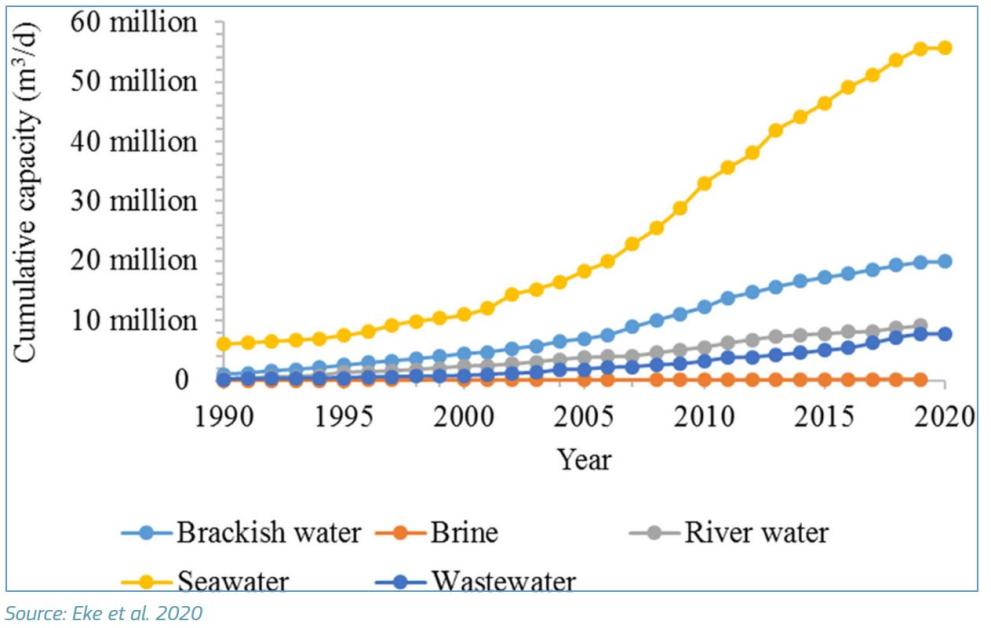
Desalination addresses global water scarcity. Almost one-fifth of the world’s population lives in areas of water scarcity, mostly in developing countries. The combination of climate change and escalating water demand is putting increasing pressure on freshwater resources. It is predicted that many regions in the EU – especially, southern European Member States - will face severe water scarcity by 2050, when water demand is expected to increase by up to 30% with the progress of global warming. According to the PESETA IV project, the population currently exposed to severe water scarcity may rise from about 50 million at present, up to 65 million people under an increase of 3°C in global average temperature1. Desalination can significantly alleviate a growing pressure on freshwater resources. Using different technologies – ranging from thermal processes such as multistage flash distillation (MSF) and thermal vapour compression (TVC) to membrane processes such as reverse osmosis (RO) – Desalination allows the removal of dissolved inorganic substances (salts and other minerals) mainly from seawater, but also from brackish water or wastewater (Figure 1)2.
Global installed capacity for the production of desalinated water has increased significantly in recent years, at an average rate of about 7% per annum since 2010, corresponding to approx. 4.6 million m3/day yearly3 In 2018, there were nearly 16 000 desalination plants worldwide4, with a total global operating capacity of roughly 95.37 million m3/day (million litres/day)5. More recent studies estimate that there were more than 21 000 seawater desalination plants in 2022, with a daily global production of 99 million m3/day of desalinated water, but also more than 150 million m3/day of brine byproduct6. Currently, desalination is largely used in the Middle East and North Africa (MENA region) – accounting for 70% of global capacity – in the US, and only to a limited extent in Europe (about 10% of global capacity).
Current desalination technologies include:
- Membrane technologies: reverse osmosis (RO) is the most frequently used technique. It consists of filtering water through membranes under high pressure that retain salt. Electrical Dialysis Reversal (EDR) is another membrane process where the salts are separated from the water by applying an electric potential difference.
- Thermally driven technologies: these use heat to evaporate water and subsequently condense it again. Thermally driven technologies include multistage flash distillation (MSF), multi-effect distillation (MED), thermal Vapour Compression (TVC) and mechanical vapour compression (MVC). Membrane distillation (MD) is an emerging hybrid thermal process making also use of membranes.
MSF and RO currently dominate the global desalination market, with the latter being by far the most widely used technology in the EU, accounting for 88.5% of total capacity. On the other hand, thermal processes are still employed to a considerable extent in the MENA region (MSF: 31%, MED: 9%), especially due to low-cost fuels and co-location with large power plants7.
Desalination plants can be classified by operational capacity as small (less than 1 000 m3/day), medium (1 000-10 000 m3/day), large (10 000-50 000 m3/day), or extra-large (over 50 000 m3/day). Plants can be installed on land, on offshore platforms, or mobile. Land-based desalination plants provide most of the world's desalination capacity (approx. 95%), while offshore-based plants represent less than 3% of installed capacity8.
Desalination is a rapidly emerging sector with a large potential. In the EU, only a relatively small fraction of freshwater is obtained through seawater desalination. Desalination in the EU has developed almost exclusively in response to territorial water shortages in the early 1990s, with small plants supplying drinking water to hotels and resorts. Given that climate change will exacerbate the natural fluctuations in seasonal water availability, it is expected that the European desalination market will expand in the coming years9.
To-date, EU facilities can supply up to 3.4 billion m3 of desalted water a year (active capacity), mainly from seawater and brackish water. There are about 2 178 desalination plants installed in the EU (Spain 41%, Greece 19%, Italy 18%, Germany 4%, and France 3%), out of which 1 779 active facilities that use seawater and brackish water, and the trend is increasing. They produce 6.86 Mm3/day of freshwater, i.e. over 80% of total production of desalinated water in Europe10.
Desalination capacity in Europe has grown significantly over the first decade of the century, with 4.58 million m3/day of new capacity between 2000 and 2009 with a total investment of €4 billion in Engineering, Procurement and Construction. Between 2010 and 2019 the new commissioned capacity was only 0.84 million m3/day with an estimated investment of €630 million. Since 2010, most of the new capacity installed was in the form of small and medium size plants. Most of the large and extra-large plants commissioned between 2000 and 2010 were built to serve large coastal cities such as Barcelona and Alicante in Spain.
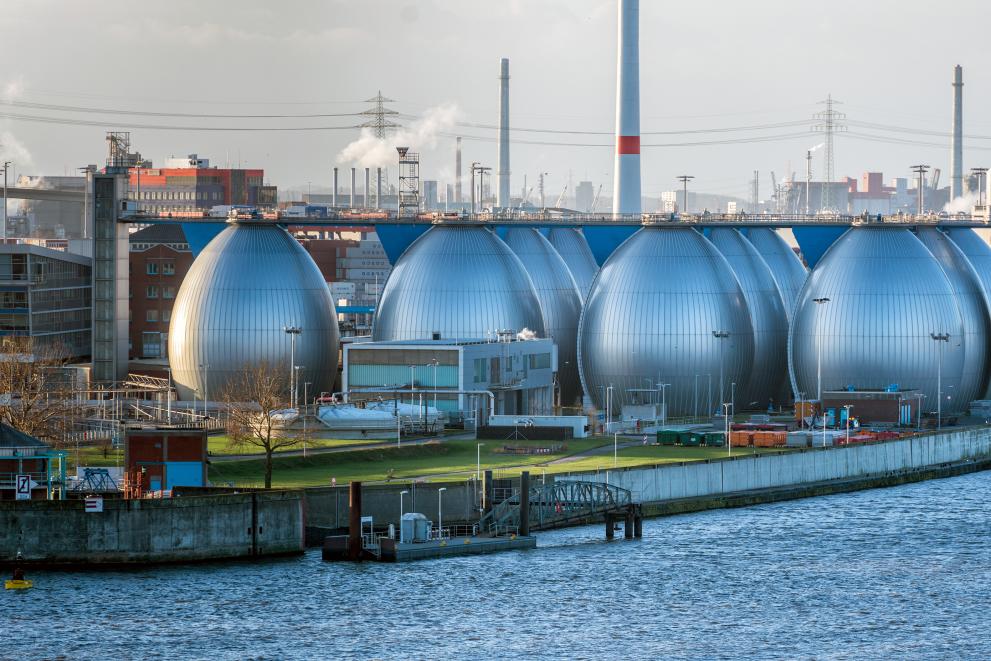
71% of the water produced is used for public water supply (2 billion m3, 4.2% of total water employed in public supply). 17% of the desalinated water produced in the EU is used for industrial applications, 4% in power plants, and 8% for irrigation11. EU desalination plants are mainly located in Mediterranean countries, where they will be mostly needed in the future: about 1 200 plants provide a capacity of 2.37 billion m3 (82% of total EU desalination capacity).
About 65% of the operational plants in the EU are located in coastal areas or offshore. The offshore plants support offshore activities, mostly oil and gas fields. The inland plants are used for the production of drinking water and industrial water; often through a process of purification of saline/brackish water present in local aquifers.
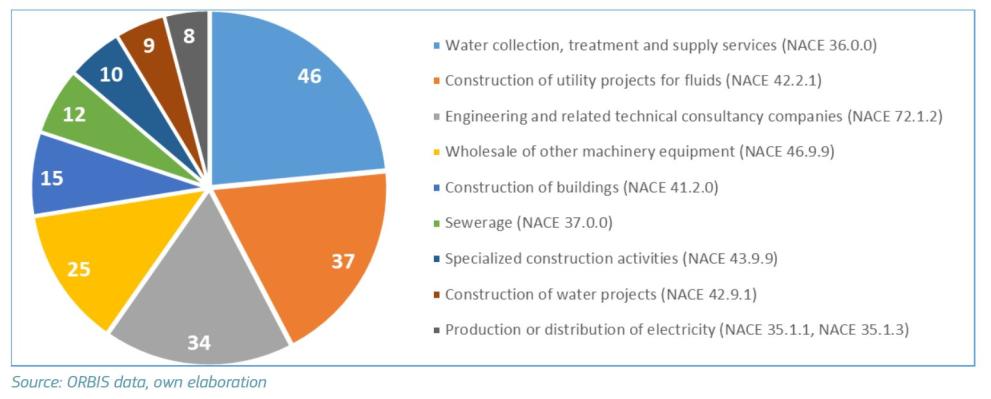
Some of the largest suppliers of desalination equipment are EU-based companies. According to the ORBIS database, a total of 413 large-scale companies headquartered in the EU-27 are active in the desalination market value chain, as per their official trade description12. Of these, 20.3% are located in France (84), followed by Germany (74) with 17.9%, Spain (59) with 14.3% and Italy (42) with 10.2%. The sectoral distribution of these companies is illustrated in Figure 2.
According to IDRA, the first among the top 20 global plant suppliers by desalination capacity contracted in the period 2014-2023, is France’s Veolia13. Included in this ranking are also the following EU-based companies: Veolia (FR), Acciona (ES), Coxabengoa (ES), Suez (FR), WeBuild/Fisia Italimpianti (IT), Tedagua (ES), Lantania (ES), GS Inima (ES), Aqualia (ES). For example, Acciona was awarded the construction of two of the world’s 20 largest desalination projects in Saudi Arabia in 2019 and 2021: the Khobar 2 (630,00 m3/day) and the Jubail 3b IWP (570,000 m3/day), which are still under construction14.
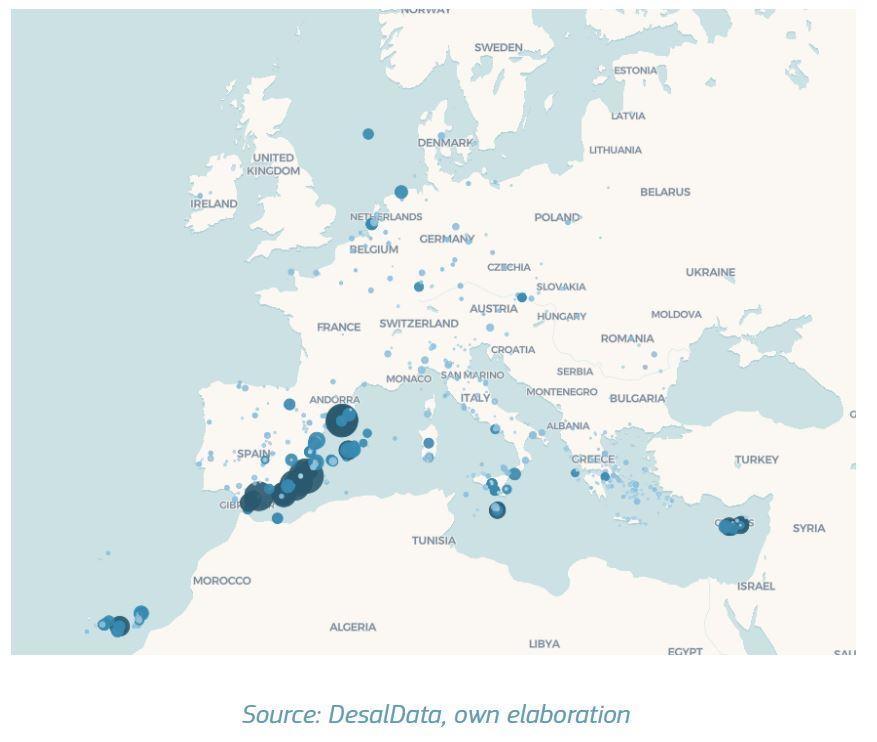
When looking at the geographic distribution of desalination plants in Europe, the picture is slightly different. Out of the 2 815 desalination plants currently on record in the DesalData database, 77.4% (2 178 plants) are located in the EU-27. 41% of them (892) are located in Spain, 18.7% (408) in Greece, 17.6% (384) in Italy, 4.5% (98) in Germany, and 2.9% (64) in France. It should be noted that not all of the plants listed above are currently active. Some are under construction, while others are still in planning stage. The geographical concentration of these plants is further illustrated in Figure 3.
The impact of the pandemic on the desalination industry was evident in terms of contracted capacity, which in 2021 decreased by 1.3 Mm3/day compared to 202015. Conversely, the operating capacity was not significantly affected, except for the temporary disruption of the supply chain, which increased the cost of desalinated water16. On a global scale, the desalination sector has now recovered from the COVID-19 pandemic, as well as from the supply chain issues and price increases that hit the global markets in 2021. In 2022, the volume of newly-contracted seawater and brackish water desalination capacity was 4.4 million m3/day, up from 3.3 million m3/day in 202117. A further 100 million m3/day of capacity that have already been contracted and are expected to become productive over the next few years. A key driver to this recovery has been a strong cycle of large-scale mega projects (>250 000 m3/day) in the MENA region, which exploit economies of scale to drive down prices. However, the development of the sector, compared to pre-COVID forecasts, still reflects a slowdown in project supply. With increased shipping costs, doubled oil prices and soaring material costs, many construction projects remained inactive during the pandemic and some were cancelled or reissued. In some cases, projects remained on hold with little prospect of recovery, while EPC prices for active projects increased by up to a third18. In the EU, this led to a contraction of the volume of newly contracted capacity, which in 2022 totalled less than 35 000 m3/day19.
Desalination is fast becoming a conventional method for water treatment globally. In line with global trends, the European desalination market is expected to enter an expansionary phase not only to address the consequences of climate change, but also to embrace policy-driven technological developments to reduce its operational costs and environmental impacts. As an illustration of this trend, in September 2023 the Spanish government announced an investment plan of more than €12 billion to mitigate the effects of droughts, stating that the funds would be used to water reuse, the construction of desalination plants and the improvement of water infrastructure. In February 2024, it was reported that two new facilities would be built south and north of Barcelona at a cost of €467 million.
Increasing the supply of desalinated water to meet the growing demand for all uses requires a significant R&D effort aimed at developing viable energy-efficient technologies and deployable solutions at scale to modernise or replace obsolete facilities, while reducing operational costs. For example, the use of next generation materials and techniques for desalination can reduce energy consumption by more than 60% compared to traditional materials and technologies (Tanaka, 2021)20(He, 2021)21. The EU supports public-private partnerships that deliver innovation in the desalination sector. Under the Horizon 2020 programme, €23.3 million were allocated to innovation actions for the period 2014-2019 (Post et al., 2021)22. Several European companies rank among the top patenting companies when it comes to the R&D related to desalination powered by renewable energy sources. The development of desalination powered by wave energy or offshore wind technology can support several offshore Blue Economy activities. However, RO innovations are mainly coming from China (45%), Japan (27%) and South Korea (1%) – while the EU contribution to global R&D on RO being rather modest (3%).
In 2020, the proportion of renewable energy used in desalination was around 1%, which explains its relatively large carbon footprint. The desalination industry must decarbonize its sources of energy in order to become more sustainable. Using an engineering costing model, it has been estimated that a large share of the population in the Mediterranean region could be serviced by photovoltaic-fuelled RO desalination at a cost below €1/m3 (Pistocchi et al., 2020). A stand-alone plant producing desalinated water with photovoltaic production on site has higher initial capital costs, but operational costs are lower, making photovoltaic-RO plants – a virtually decarbonised solution – competitive in the long run. Other renewable energy sources may be equally valid. For instance, the EU-funded H2020 W2O project demonstrated the economic viability of the world’s first wave-driven desalination system, Wave2O. This operates completely ‘off-grid’ to supply large quantities of affordable fresh water (Cordis, 2024).
Desalination can create harmful environmental impacts on marine ecosystems. The process of extracting salt from seawater requires large amounts of energy. Insofar as this energy originates from fossil fuels, it contributes to greenhouse gas emissions and climate change. Moreover, the discharge of brine (salt-saturated water) back into the ocean can disrupt the balance of salinity, affecting marine flora and fauna. Approximately 1.5 litres of brine are produced as waste for every litre of fresh water.As brine is heavier than normal seawater, it accumulates on the seafloor, threatening species which are sensitive to the level of salinity23. The potential environmental impact of desalination underscores the need for sustainable practices in desalination processes and brine disposal, in line with the provisions of the EU Biodiversity Strategy24 and the EU Zero Pollution Action Plan25.
Energy: Desalination is an energy-intensive process, which drives important efforts in terms of renewable energy applications and related R&D investments. Energy is required not only in the separation step itself, but also in water pumping, pre- and post-treatment, brine disposal pumping, etc. Conventional desalination systems require connection to the electricity grid, which might be problematic for isolated sites, especially islands. The electricity requirements vary according to the desalination technology, the salinity of the water source and the desired level of purity of the desalted water at the end of the treatment. While the high energy demand of desalination may cause local issues on the power grid at some sites, there is a potential to develop strategies for the improvement of plant autonomy using photovoltaic energy.
Planning & Operation: As a result, operating costs are high. Seawater desalination operating costs range between 0.35 and 1.87 $/m3, registered in 2012 and 2004 respectively26. The average price of desalinated seawater by RO in the Mediterranean Sea has been estimated at between EUR 0.65/m3 (World Bank, 2019)27 and €0.86/m3 (Pistocchi et al., 2020)28. However, the energy crisis triggered by Russia’s military aggression against Ukraine has recently pushed up energy prices. Other main drivers of costs are the used technology, plant size and configuration, quality of feedwater and of desalinised water, and environmental compliance requirements. Most of these factors are site-specific in nature. Costs of conveyance and distribution of water are also important, and there are cost advantages for plants located near the coast and on low-lying land (due to lower energy needs for transport upwards; a 100-meter vertical lift is about as costly as a 100-kilometer horizontal transport). Overall, thermal desalination technologies, particularly MSF plants, are more capital-intensive than SWRO. However maintaining and operating costs for SWRO plants for each unit of output are double than those of MSF plants, and three times than those of MED plants. For both technologies, but particularly for thermal plants, energy is far and away the largest single item of recurrent cost. For this and other reasons, MED/MSF technologies are losing market shares in favour of RO29. The quality of the source water (such as salinity, temperature, and biofouling elements) affects costs, performance, and durability, but also the water quality that can be achieved through the desalination process.
Carbon footprint: Insofar as desalination plants use fossil fuels, the sector’s carbon footprint can be particularly high. The desalination of 1 000 m3 per day consumes approximately the equivalent of 10 000 tons of oil per year. The carbon footprint of seawater desalination by reverse osmosis (RO) has been calculated at between 0.4 and 6.7 kilograms of CO2 equivalent per cubic meter (kg CO2eq/m3). This means that desalination of 1 000 m3 of seawater could potentially release up to 6.7 tons of CO230.
Waste management: Desalination generates other negative environmental externalities due to discharges of concentrated brine streams31. Brine produced by the desalination process contains chemicals used during the pre-treatment phase, which threaten a number of species that are sensitive to the level of salinity32. Therefore, brine disposal impacts must be appropriately mitigated in order to avoid adverse impacts on the marine environment33. Mitigation efforts combined with stricter discharge regulations (Morillo et al., 2022)34and technological advancements are crucial for sustainable desalination. The FP7 and H2020 projects Zero Brine and Water-Mining, focus on reducing brine residues and therefore reducing their environmental impacts, while at the same time recovering the minerals for reuse in other industries, and making the water reusable as well.
Desalination for agriculture
Climate change is imposing severe and escalating pressures on freshwater resources across Europe with significant implications for the agricultural sector, as rising temperatures, shifting rainfall patterns, glacier melting, and more frequent extreme weather events (droughts and floods) have already impacted crop yields, livestock production, and farmer livelihoods across the region35. Prolonged droughts have long been causing widespread agricultural losses affecting southern European countries most acutely but also causing impacts in central and northern areas previously unaffected by water scarcity36. Recent estimates put the current annual losses due to drought at around €9 billion for the EU and the UK, with the highest losses in Spain (€1.5 billion per year), Italy (€1.4 billion per year) and France (€1.2 billion per year), of which, depending on the region, those affecting agriculture range between 39-60%37.
Projections indicate the agricultural impacts of climate change will intensify in the coming decades as, under medium and high emission scenarios, droughts that currently occur every 100 years could happen every 10-30 years on average in southern Europe by the 2070s38. Such intensification threatens severe, widespread consequences for European agriculture, potentially endangering regional food security39. Against this backdrop, desalination is considered as a promising option for making agriculture less dependent on rainfall and utilising water sources that are considered unusable without treatment40, such as inland brackish water and wastewater.
In Europe, Spain is increasingly reliant on desalination as a key water source for agriculture, as well as Greece and Cyprus, to supplement irrigation water, primarily for the growth of fruits, vegetables, and grapes.
Spain, for instance, has one of the world’s most extensive seawater desalination capabilities, with major facilities, such as Torrevieja, Alicante I and Valdelentisco plants. These facilities employ reverse osmosis technology to produce over 200 million m3 of water annually. Besides being supplied to the municipalities as drinking water, this water is channeled to irrigation districts in the southeastern Murcia region, which predominantly produce fruit, vegetables, and grapes41. Studies suggest that, during drought periods, when surface water resources are strained, desalinated water constitutes between 50-80% of the total agricultural irrigation supply in this region.42
In Greece, a combination of seawater desalination and treated wastewater reuse fulfills up to 60% of the irrigation demand for major greenhouse horticulture crops, including tomatoes. This approach is particularly crucial in drought-prone areas around Athens during the summer months43. Similarly, on the Island of Cyprus, where seasonal droughts are a common occurrence, brackish water desalination and seawater desalination account for over 15% of the total agricultural irrigation supply.44Here, citrus fruits are particularly reliant on desalinated water for growth. However, studies indicate risks associated with the long-term use of desalinated water for irrigation, including soil salinisation. This requires more effective regulation on appropriate irrigation methods and crop selection to prevent soil degradation45. For example, desalinated water requires boron control in order to avoid toxicity to plants, a cost-intensive process which can be mitigated if the water is blended with other sources.
Some of the main challenges and opportunities to scale up desalination for agriculture include:
- The high cost of desalinated water and its negative environmental impact, primarily caused by energy requirements and brine management, remain major challenges. The estimated cost of desalinated water for irrigation ranges from 0.50€ to 2€ per cubic metre46. For comparison, farmers are often charged between 0.05€ to 0.35€ per cubic metre for surface irrigation water, while unconventional sources such as reclaimed wastewater may cost between 0.15€ to 0.60€ per cubic meter47. However, it should be noted that currently many European countries undervalue water from conventional surface and groundwater sources, which makes desalination appear expensive in comparison48. The greater cost of desalinated water makes it difficult to be competitive without subsidies, except for crops with high profit margins.
- Energy-wise, transitioning to renewable electricity sources, such as solar and wind, that are becoming cost-competitive with fossil fuels could reduce costs49. However, intermittent power generation from renewables affects reliability of water supply, necessitating storage or flexible on-demand operation capability. Pressurised irrigation techniques such as subsurface drip irrigation are amenable to the on-off intermittent supply patterns from renewables-powered desalination systems50.
- While technical and economic hurdles remain, RO desalination of saline water coupled with renewable energy has promising potential to provide alternative irrigation water sources. RO has emerged as the most widely used and suitable desalination technology due to its modularity, declining costs, and reliability compared to thermal distillation processes51. To employ desalinated water for direct uses on soil, it has to be blended with other water sources, to compensate for its lack of nutrients (calcium, magnesium, sulphur) needed for plant growth and soil health, and must undergo a targeted remineralisation to reduce its corrosivity52.
- Desalination can help replenish the water cycle: when desalination is coupled with water reuse for irrigation, there is a net transfer of water to the land phase of the hydrologic cycle. This may help mitigate the hydrological impacts of climate change in regions such as southern Europe. In addition to reducing groundwater abstraction, reuse of desalinated water for irrigation can for example facilitate agriculture, ecosystem restoration and vegetation growth in otherwise unproductive regions53.
- As regards brine disposal, it can become an issue when considering the use of desalination plants to support agricultural water needs. There have been several studies on how to mitigate the negative effects of brine54, but also on how to use it to agricultural advantage, such as reusing it in hydroponic culture55.
Figure 1: Feed water sources of global desalination capacity
The graph by Eke presents the sources of feedwater used globally in desalination plants. Desalination is the process of removing salts and other impurities from water to make it suitable for drinking or industrial use. The graph categorises the primary sources of water that are desalinated.
Seawater: This is the most common source of feedwater for desalination. The graph likely shows it as the largest portion, representing the bulk of global desalination capacity.
Brackish Water: This refers to water that is saltier than freshwater but less salty than seawater, such as water from estuaries or underground sources. It's likely represented as the second-largest segment.
River Water: Freshwater sources such as rivers also contribute to desalination, though typically to a lesser extent. The graph may show this as a smaller portion.
Wastewater: Some desalination plants treat wastewater to recycle it for use. This segment might be smaller compared to seawater or brackish water.
Brine water: is with a high-concentration solution ofsalt (typically sodium chloride or calcium chloride).
Figure 2: Sectoral distribution of large companies active in the desalination value chain in the EU-27
This graph from ORBIS shows how large companies involved in the desalination value chain are distributed across various sectors in the EU-27. The desalination value chain includes all the activities and industries that contribute to the production, operation, and maintenance of desalination technology.
1 Bisselink B., Bernhard J., Gelati E., Adamovic M., Guenther S., Mentaschi L., Feyen L., and de Roo, A, Climate change and Europe’s water resources, EUR 29951 EN, Publications Office of the European Union, Luxembourg, 2020, ISBN 978-92-76-10398-1, doi:10.2760/15553, JRC118586.
2 Eke, J., Yusuf, A., Giwa, A., & Sodiq, A. (2020). The global status of desalination: An assessment of current desalination technologies, plants and capacity. Desalination, 495, 114633
3 Bisselink B., Bernhard J., Gelati E., Adamovic M., Guenther S., Mentaschi L., Feyen L., and de Roo, A, Climate change and Europe’s water resources, EUR 29951 EN, Publications Office of the European Union, Luxembourg, 2020, ISBN 978-92-76-10398-1, doi:10.2760/15553, JRC118586.
4 Of these, 11,724 are currently operating, representing 85% of the total number of facilities and accounting for 92% of the global capacity.
5 Jones, E., Qadir, M., van Vliet, M. T., Smakhtin, V., & Kang, S. M. (2019). The state of desalination and brine production: A global outlook. Science of the Total Environment, 657, 1343-1356
6 Eyl-Mazzega M.A. and É. Cassignol, (2022). The Geopolitics of Seawater Desalination, Études de l’Ifri, IFPRI, September 2022.
Sirota, R., Winters, G., Levy, O., Marques, J., Paytan, A., Silverman, J., ... & Bar-Zeev, E. (2023). Impacts of Desalination Brine Discharge on Benthic Ecosystems. Environmental Science & Technology.
7 DesalData
8 DesalData
9 de Roo et al. 2021. The Water-Energy-Food-Ecosystem Nexus in the Mediterranean: Current Issues and Future Challenges. The Water-Energy-Food-Ecosystem Nexus in the Mediterranean: Current Issues and Future Challenges.
de Roo et al. 2023. Water-Energy-Food-Ecosystems pathways towards reducing water scarcity in Europe
10 DesalData
11 Adamovic et al. 2019. Energy Nexus in Europe. EC Joint Research Centre. doi:10.2760/285180, JRC115853.
12Out of a total of 5045 companies having the “desalination” in their trade or product descriptions (in any of EU-27 languages), 413 companies are headquartered in the EU-27.
13 IDRA Desalination & Reuse Handbook 2023 -2024, Water Desalination Report, pg. 15
14 IDRA Desalination & Reuse Handbook 2023 -2024, Water Desalination Report, pg. 4
15 IDRA Desalination & Reuse Handbook 2023 -2024, Water Desalination Report.
16 DesalData Market Report, July 2023.
17IDRA Desalination & Reuse Handbook 2023 -2024, Water Desalination Report.
18 Ibidem
19 DesalData: European market.
20 Tanaka, Y. (2021). Current progress in reverse osmosis desalination. NPG Asia Materials, 13(1), 1-29. https://doi.org/10.1038/s41427-021-00338-5.
21 He, Z. (2021). Hybrid thermal processes. In Z. He & K. Sirkar (Eds.), Desalination: Fundamentals, advances and technologies (pp. 77-95). Academic Press.
22 Post J., de Jong P., Mallory M., Doussineau M., Gnamus A. (2021). Smart Specialisation in the Context of Blue Economy – Analysis of Desalination Sector. Publications Office of the European Union, Luxembourg, doi:10.2760/058360.
23 European Environment Agency, 2012. EEA Report No 1/2012. Towards efficient use of water resources in Europe.
24 COM/2020/380 final.
25 COM/2021/400 final
26 Eke, J., Yusuf, A., Giwa, A., & Sodiq, A. (2020). The global status of desalination: An assessment of current desalination technologies, plants and capacity. Desalination, 495, 114633.
27 World Bank. (2019). The role of desalination in an increasingly water-scarce world. World Bank
28 Pistocchi, A., et al. (2020). Can seawater desalination be a win-win fix to our water cycle? Water research, 115906. https://doi.org/10.1016/j.watres.2020.115906.
29 Zolghadr-Asli, B., McIntyre, N., Djordjevic, S., Farmani, R., Pagliero, L., Martínez-Alvarez, V., & Maestre-Valero, J. F. (2023). A review of limitations and potentials of desalination as a sustainable source of water. Environmental Science and Pollution Research, 30(56), 118161-118174.
30 IFRI, 2022. The Geopolitics of Seawater Desalination.
31 European Environment Agency, 2021. Water resources across Europe - confronting water stress: an updated assessment. EEA Report No 12/2021
32 European Environment Agency, 2012. EEA Report No 1/2012. Towards efficient use of water resources in Europe.
33 Pistocchi, A., Bleninger, T., & Dorati, C, 2020. Screening the hurdles to sea disposal of desalination brine around the Mediterranean. Desalination, 491, 114570
34 Morillo, J., Lee, K. P., & Shon, H. K. (2022). Towards zero brine discharge: Progress, remaining challenges, and future outlooks of inland brine treatment technologies. Journal of Environmental Management, 300, 113861. https://doi.org/10.1016/j.jenvman.2021.113861.
35 Cammalleri, C., Naumann, G., Mentaschi, L., Bisselink, B., Gelati, E., De Roo, A., and Feyen, L.: Diverging hydrological drought traits over Europe with global warming, Hydrol. Earth Syst. Sci., 24, 5919–5935, 2020, https://doi.org/10.5194/hess-24-5919-2020
36 COM(2012), Communication from the Commission to the European Parliament, the Council, the European Economic and Social Committee and the Committee of the Regions, “Report on the Review of the European Water Scarcity and Droughts Policy”: https://eur-lex.europa.eu/legal-content/EN/TXT/?uri=celex%3A52012DC0672
37 Cammalleri C., Naumann G., Mentaschi L., Formetta G., Forzieri G., Gosling S., Bisselink B., De Roo A., and Feyen L, JRC Technical Report, 2020, “Global warming and drought impacts in the EU”, doi: 10.2760/597045
38 Spinoni, J.et al, “Future Global Meteorological Drought Hot Spots: A Study Based on CORDEX Data”. J. Climate, 33, 3635–3661, 2020, https://doi.org/10.1175/JCLI-D-19-0084.1
39 Webber, H., Ewert, F., Olesen, J.E. et al. Diverging importance of drought stress for maize and winter wheat in Europe. Nat Commun 9, 4249, 2018, https://doi.org/10.1038/s41467-018-06525-2
40 Jones, E., Qadir, M., van Vliet, M.T., Smakhtin, V., & Kang, S. mu. (2019). The state of desalination and brine production: A global outlook. Science of The Total Environment, 657, 1343-1356, 2019, https://doi.org/10.1016/j.scitotenv.2018.12.076
41 Del Amor et al. 2020. Integrated Water Management in Southeast Spain: Assessment of Total Water Cycle. Water. 12(6):1803.
42 Martínez-Alvarez et al. 2016. Seawater Desalination for Crop Irrigation – A Review of Current Experiences and Revealed Key Issues. Desalination. 381: 58-70.
43 Chartzoulakis et al. 2010. Water Resources Management in Crete (Greece) including Water Recycling and Desalination. Agricultural Water Management. 98(1): 96-105
44 Polycarpou and Zachariadis 2013. An Econometric Analysis of the Use of Desalinated Water in Cyprus. Water Resources Management. 27(7): 2089-2101.
45 Poulakis et al. 2015. Overview of Water Quality Problems in Three Regions of Intensive Agriculture in Greece and Agricultural Practices to Minimize the Impact on Water Resources. Global Nest Journal. 17(4): 721-732.
46 Karagiannis, I. C., & Soldatos, P. G., “Water desalination cost literature: review and assessment.” Desalination, 223(1-3), 448-456, 2008, https://doi.org/10.1016/j.desal.2007.02.071
47 Zhu, T., Ringler, C., & Rosegrant, M. W. Viewpoint – Potential for irrigation infrastructure expansion in Africa from an economic perspective. Water Alternatives, 13(3), 610-626, 2020, http://www.water-alternatives.org/index.php/volume13/v13issue3/557-a13-3-8
48 ProDes. (2010). Schemes for subsidizing renewable energy driven desalination. https://www.prodes-project.org/fileadmin/Files/D6_3_Schemes_for_subsidizing.pdf
49 IRENA. (2020). Renewable power generation costs in 2019. International Renewable Energy Agency. https://www.irena.org/publications/2020/Jun/Renewable-Power-Costs-in-2019
50 FAO. (2012). Coping with water scarcity: An action framework for agriculture and food security. http://www.fao.org/3/i3015e/i3015e.pdf
51 FAO. (2019). The State of the World’s Land and Water Resources for Food and Agriculture – Systems at breaking point. Synthesis report 2019. http://www.fao.org/3/ca7173en/CA7173EN.pdf
52 Jones, E. et al, (2019). The state of desalination and brine production: A global outlook. Science of The Total Environment, 657, 1343-1356, 2019, https://doi.org/10.1016/j.scitotenv.2018.12.076
53 Pistocchi, A., Bleninger, T., Breyer, C., Caldera, U., Dorati, C., Ganora, D., ... & Zaragoza, G. (2020). Can seawater desalination be a win-win fix to our water cycle?. Water Research, 182, 115906. https://doi.org/10.1016/j.watres.2020.115906
54 Wei Han Tu et all. “Reclaimed seawater discharge – Desalination brine treatment and resource recovery system”, Water Research, Volume 251, 2024, 121096, ISSN 0043-1354, https://doi.org/10.1016/j.watres.2023.121096
55 David Jiménez-Arias, Sarai-Morales Sierra, Fráncisco J. García-Machado, Ana L. García-García, Andrés A. Borges, Juan C. Luis “Exploring the agricultural reutilisation of desalination reject brine from reverse osmosis technology” Desalination, Volume 529, 2022, 115644, ISSN 0011-9164, https://doi.org/10.1016/j.desal.2022.115644