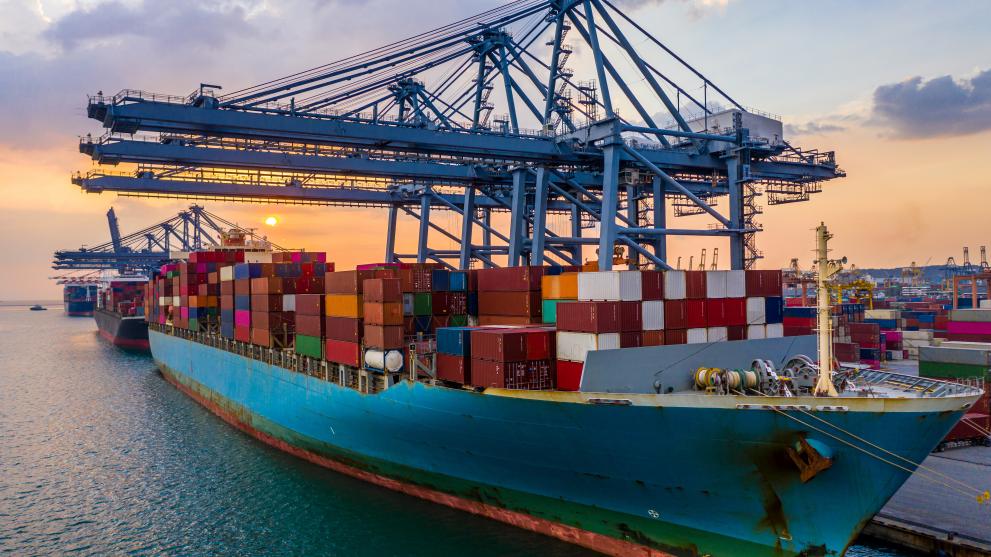
Globally, approximately 13 billion tonnes of traded goods were transported by sea in 2024, a 2.2% increase from the previous year, exceeding the 2013-2023 average (1.8%) but showing a long-term deceleration when compared to the 2003-2023 average (2.9%)1
When looking at the distance-adjusted volumes, global seaborne trade increased by 5.9% in 2024 and totaling almost 67 trillion ton-miles due to significantly longer distances travelled (5 245 miles on average per trip in 2024 compared to 4 831 miles in 2018)2caused by logistical disruptions in the Red Sea, Panama Canal and the Strait of Hormuz, and to strategic changes in imports of crude oil and refined products (e.g. EU imported less from Russia and more from US and Middle East). A zoom onto shipping within EU Exclusive Economic Zones reveals that a total of 4.8 trillion kilometer-tonnes were transported, in line with the previous year and 6.4% less than in 2022.3

However, the EU-27 picture is different, as the gross weight of goods handled in ports remained fairly stable around 3.4 billion tonnes in 2024 (-0.2% on a yearly basis), reporting a similar trend by quarters.
When zooming at Member State level, the year-on-year (2024 over 2023) rate of gross weight of goods handled is very heterogeneous, spanning from -38% in Malta (4.5 million tonnes) to +6.1% in Lithuania (39.5 million tonnes). The Netherlands recorded the largest gross weight of goods handled at 538 million tonnes (-1.3% from 2023), followed by Spain with 486 million (+3%) and Italy with 477 million (-0.1%).
Liquid bulk goods (e.g. oil) represented roughly 37.3% of the total goods handled in EU (1.24 billion tonnes), followed by large containers with 24.7% (819 million tonnes) and dry bulk goods (e.g. grain) with 20.6% (684 million tonnes). The Member State that handled the most liquid bulk goods was the Netherlands (255 million tonnes), followed by Italy (196 million tonnes). Spain handled the most containers (155 million tonnes), followed by Belgium (114 million tonnes) and Germany (109 million tonnes).

The Netherlands also handled most dry bulk goods (132 million tonnes), followed by Spain (95 million tonnes).
Short sea shipping (SSS) is defined as the maritime transport of goods between ports in the EU (sometimes also including candidate countries and EFTA countries) on the one hand, and ports situated in geographical Europe, on the Mediterranean and Black Seas on the other hand. In 2024, 1.65 billion tonnes of goods were transported, 3.1% more than in the previous year. Italy (304 million tonnes), the Netherlands (239 million tonnes) and Spain (220 million tonnes) accounted for more than 46% of EU short sea shipping in 2024. The busiest region for SSS was the Mediterranean Sea, where roughly 39% of the goods were transported in terms of gross weight (647 million tonnes), followed by the North Sea (29% and 472 million tonnes) and the Baltic Sea (18% and 294 million tonnes). Liquid bulk (39% and 640 million tonnes) was the dominant type of cargo in EU SSS, followed by dry bulk (20% and 335 million tonnes) and containers (18% and 295 million tonnes).

In 2024, 21.7 billion passenger-kilometer were recorded within the EU Exclusive Economic Zones, a 2% increase on the previous year. In terms of passengers, this equaled 400 million passengers (excluding cruise passengers) that embarked and disembarked in all EU ports, a 5.9% increase compared to 2023. Cruise passengers were roughly 18 million, 12.1% more than the previous year, confirming a highly positive trend that surpassed pre-COVID-19 levels by large (15 million in 2019). Italy recorded the highest number of passengers (including cruise) embarking and disembarking from its ports, tallying 93.5 million (12% more than the previous year), followed by Greece with 81.1 million (8% up) and Denmark with 41.3 million (in line with the previous year). There is a minimal difference between the count of passengers disembarking ('inwards') and embarking ('outwards') at EU ports. This phenomenon underscores the predominant reliance on national or intra-EU ferry services for seaborne passenger transport in Europe.

Based on the Liner Shipping Connectivity Index (LSCI), which indicates a country's integration into global liner shipping networks, the most-connected European economies in the last quarter of 2025 were Spain (-1.1% from Q4 in 2024), the Netherlands (+1.9%) and Belgium (-1.1%). Cyprus recorded the biggest improvement (+33.9% on a yearly basis), followed by Denmark (+13.0%) and Polan (+7.8%), whilst Romania’s index dropped the most (-19.0%), followed by Bulgaria (-15.2%) and Lithuania (-12.0%).
The most connected EU ports in the last quarter of 2025 were Rotterdam (NL, +1.2% compared to the same quarter in 2024), Antwerp (BE, -2.8%) and Hamburg (DE, +5.2%), according to the Port liner shipping connectivity index (PLSCI), which measures a port's integration into global liner shipping networks. The port of Vado Ligure (IT) recorded the largest increase compared to the previous year (+54.8%), followed by the Swedish port of Halmstad (+52.7%) and the Spanish port of Gijon (49.5%). The biggest drop was recorded by the ports of Aalborg (DK, -59.2%), Oulu (FI, -54.4%) and Tornio (FI, -45.0%).
For more detailed information on Port activities, consult the section on the EU Blue Economy Observatory.

Maritime transport includes the following sub-sectors:
- Passenger transport includes the transport of passengers on vessels designed for operating on sea or coastal waters as well as the transport of passengers on inland waters;
- Freight transport includes the transport of freight on vessels designed for operating on sea or coastal waters as well as the transport of freight on inland waters;
- Services for transport includes renting and leasing of water transport equipment as well as other support activities (Table 1)
The maritime transport sector generated a GVA of EUR 53.2 billion in 2023, a 14% decrease compared to 2022. Gross profit, at EUR 33.8 billion, decreased by 23% on the previous year. The turnover reported for 2023 was EUR 211.2 billion, a 7% decrease on the previous year (Figure 1).
In 2023, 396 200 persons were directly employed in the sector, 1% more than in 2022. The annual average wage was estimated at EUR 49 100, up 8% compared to 2022.
In 2023, the maritime transport sector accounted for 19.4% of the jobs, 20.8% of the GVA and 29.5% of the profits in the EU Blue Economy.

Table 1 reports the list of activities that underpin each sector
The complete methodology is reported on the EU Blue Economy Observatory:
| Sector | Sub-sector | Activity |
| Maritime transport | Passenger transport |
|
| ||
| Freight transport |
| |
| ||
| Services for transport |
| |
|
Germany recorded the highest employment within Maritime transport, contributing with 32% of jobs in the sector, followed by Italy (18%) and France (10%). Germany generated 31% of the Members States’ GVA in the sector, followed by Denmark (21%) and Italy (13%) (Figure 2).
In 2023, about 50% of the jobs (196 900) were within the sub-sector Services for transport, while Passenger transport (104 200) and Freight transport (95 100) employed respectively 26% and 24% of people.
In terms of GVA, Freight transport generated about 56% of the sector’s GVA (EUR 29.8 billion), followed by Services 26% (EUR 13.8 billion) and then Passenger transport with 18% (EUR 9.6 billion).
For more detailed economic and social data, please consult the dashboard on the Blue Economy Indicators.

Trends and drivers
The EU maritime transport sector is undergoing significant transformation driven by evolving geopolitical dynamics, digitalisation, energy transition as well as inThe EU maritime transport sector is undergoing significant transformation driven by evolving geopolitical dynamics, digitalisation, energy transition as well as increasing climate risks. Global political uncertainties impact trade routes and supply chains, emerging technologies and automation are reshaping operations, while the shift to alternative fuels and stricter environmental regulations accelerate decarbonisation efforts. At the same time, climate change intensifies risks such as extreme weather events and changing sea levels.
A comparison of the EU-27 GDP growth rate, goods handled in ports and passengers embarked/disembarked in EU ports reveals a strong correlation between these indicators (Figure 3), suggesting that maritime trade is largely dictated by developments in the economy.
Considering maritime transport’s strategic role in the EU economy, the sector’s transformation in response to the evolving dynamics requires a set of sectoral and cross-sectoral policies that allow the EU and its Member States to regulate and progress towards strategic goals. These policies touch on issues such as trade and the internal market, international cooperation, safety and the environment, security, decarbonization, digitalization, research, as well as education, training and employment. Advancing this policy framework, the Commission launched the EU Industrial Maritime Strategy to ensure a competitive, sustainable and resilient sector, along with an EU ports strategy. The Strategy acknowledges the challenges that the maritime manufacturing and shipping industries face and addresses them in six pillars: Build, equip and repair; Transport and connect; Secure and protect; Access to innovation; Access to finance and investment; and Access to skills and quality jobs.
Route changes due to geopolitical factors:
Over the past two decades, the maritime transport sector has undergone a significant structural transformation. While the overall trend has been one of growth, trade patterns, shipping routes, and traffic configurations have been reshaped by geopolitical factors. The geopolitical tensions represent one of the most significant risks to global maritime trade in decades. These factors threaten the stability of key trade routes, disrupt supply chains, and contribute to mounting economic uncertainty. After strong growth in 2024, seaborne trade was expected to stall in 2025, with volumes barely rising.
Maritime chokepoints, which serve as essential arteries for global commerce, are particularly vulnerable. With few viable alternatives, disruptions at these strategic passages can trigger far-reaching consequences, impacting food security, energy supply, and economic stability worldwide. A prominent example is the disruption of transit in the Strait of Hormuz, one of the most critical maritime transport chokepoints, due to the conflict in the Middle East that started in February 2026. Transit almost came to a halt by the beginning of March, dropping from around 140 daily ship transits to fewer than 10, marking a 97% decrease. With over a quarter of oil transport and significant shares of LNG and chemicals (i.e. fertilisers) passing through the Strait (see Figure 4), the consequences are expected to be very severe, with sharp drops in supply causing immediate increases in prices. The direct impact on energy product transit will inevitably generate ripple effects on global value chains.
Security risks in the Red Sea continued to cause major disruptions to transit levels through the Suez Canal. By early May 2025, traffic was still around 70% lower than the 2023 average[1]. In response, a significant share of ships on the Asia–Europe trade route continued to divert around the Cape of Good Hope, increasing import costs[2]. Although there were signs of tensions easing during the second half of 2025, the instability in the region caused by the Middle East conflict is likely to continue affecting this passage.
The Straits of the Dardanelles, the Sea of Marmara, and the Bosphorus (hereafter, the Straits) continue to be a sensitive point for maritime transport. Amid geopolitical tensions in the Black Sea and the Middle East, and increasing congestion, transit through the Straits has become more complex and less predictable, reinforcing their role as a critical chokepoint in global maritime trade.
The Panama Canal connects the third most important trade route for the EU, between Latin America’s west coast and Europe[3]. After the droughts that caused disruptions in 2023 and 2024, affecting trade to and from the EU[4], some political uncertainty remains linked to the control of the Canal. In this regard, in April 2025 Panama decided to withdraw from China’s Belt and Road Initiative following US pressure and statements about potentially reclaiming control of the canal due to perceived Chinese influence and excessive prices charged for US ships’ passage[5].
Although not a chokepoint per se, tensions surrounding Greenland’s sovereignty highlight its growing relevance for European maritime transport, as the island lies close to emerging Arctic shipping routes that could significantly shorten connections between the Atlantic and Pacific and complement traditional trade corridors. As sea ice declines and Arctic navigation becomes more viable, Greenland’s strategic location for maritime infrastructure, logistics hubs and route monitoring underscores its importance for the governance and security of future Arctic shipping lanes[6].
Finally, the imposition of new tariffs by the US and the response from other countries in turn, have also introduced uncertainty regarding the extent of their potential impact on maritime shipping. Initial estimates reported by IUMI suggest that around 5% of global seaborne trade could be affected[7]. Along the same lines, estimates from UNCTAD suggest a decrease of between 5% and 10%, depending on the scenarios, with a higher impact on China and developing economies[8]. However, as events are still unfolding, it is too early to assess the full implications, particularly as the legality of the new tariffs has been challenged in U.S. courts, including by the Supreme Court.
The combination of geopolitical tensions and tariff announcements led to increased volatility in container freight rates in 2025[9]. In Europe, after a peak in spot freight rates on the Asia–Europe corridor in 2024, the EU’s main import route, prices declined in 2025, except for a partial recovered in June (see Figure 5). Ongoing tensions continue to add unpredictability to shipping markets.
Addressing these vulnerabilities requires urgent action to strengthen the resilience of global supply chains and ensure uninterrupted maritime trade. Diversifying shipping routes is crucial to reducing dependency on a limited number of critical passages, while greater cooperation among shippers, logistics providers, and ports can help optimise supply chain efficiency. At the same time, leveraging technology, data, and predictive analytics will improve demand forecasting, enhance early warning systems, and enable better capacity management at chokepoints, contributing to mitigate the risks posed by geopolitical instability and climate change.
[1] Review of maritime transport 2025: Staying the course in turbulent waters (UNCTAD/RMT/2025) eISBN: 978-92-1-159177-4. UNCTAD
[2] Red Sea, Black Sea and Panama Canal: UNCTAD raises alarm on global trade disruptions. UNCTAD News (accessed 17/03/2026)
[3] The Panama Canal: Panama's sovereign rights under threat? European Parliamentary Research Service
[4] Navigating Troubled Waters: Impact to Global Trade of Disruption of Shipping Routes in the Red Sea, Black Sea and Panama Canal. UNCTAD Rapid Assessment
[5] The Panama Canal: Panama's sovereign rights under threat? European Parliamentary Research Service
[6] Greenland: Caught in the Arctic geopolitical contest. European Parliamentary Research Service, Members’ Research Service
[7] IUMI’s 2025 analysis of the global marine insurance market. IUMI
[8] Review of maritime transport 2025: Staying the course in turbulent waters (UNCTAD/RMT/2025) eISBN: 978-92-1-159177-4. UNCTAD
[9] Review of maritime transport 2025: Staying the course in turbulent waters (UNCTAD/RMT/2025) eISBN: 978-92-1-159177-4. UNCTAD
Digitalisation
Digitalisation is a cross-cutting driver in maritime transport governance, supporting safety, security, environmental protection and regulatory compliance. However, despite growing operational and environmental demands, the digitalisation of European maritime logistics remains uneven and largely underdeveloped. According to the European Maritime Transport Environmental Report 2025, digital technologies are still treated as a secondary tool rather than an essential infrastructure component. This mismatch underscores the need for a rapid digital modernisation of Europe’s transport systems. Beyond maintaining physical infrastructure, the EU must advance towards interoperable digital platforms, real-time traceability, automated documentation systems, and modal synchronisation. In this regard, the European Maritime Safety Agency (EMSA) continues to advance these areas through its dedicated platforms while, in parallel, pursue the simplification of systems through the roll-out of the European Maritime Single Window environment (EMSWe in Fig. 6), which acts as a front end to enhance the interoperability between existing EU maritime information systems (EMSA, 2026). The main platforms are:
- SafeSeaNet: the EU’s central maritime information exchange system, ensuring secure and continuous data flows between national authorities,
- Integrated Maritime Services (IMS): provides authorities with a single operational picture by combining vessel tracking, behavioural analysis, Earth observation data and contextual layers such as weather or operational alerts,
- THETIS inspection and reporting tools: support different aspects such as State port control, MRV and emissions trading, compliance of FuelEU Maritime and the Ship-Source Pollution Directive.
Different technologies can contribute to further advancing in the digitalisation of the maritime sector. The integration of real-time AIS data with advanced technologies such as big data analytics, artificial intelligence and modern communication systems is already transforming the sector. These tools enable more efficient operations, safer navigation and greater responsiveness to changing market conditions. However, unlocking their full potential requires overcoming challenges related to cybersecurity, regulatory frameworks and workforce adaptation.
The European Union also promotes the development of digitalisation through the funding of research projects. In this regard, the CORDIS portal on research results provides examples focusing on different topics. Related to ship design, monitoring and maintenance, the D-NAVIO project uses AI and digital twin technology with the goal of making maritime transport safer, smarter and more sustainable throughout its lifecycle. The VesselAI project leverages AI technology to predict vessel behaviour and manoeuvring, including the human factor, ship energy design optimisation, autonomous shipping and fleet intelligence. Finally, the MARINA project aims to reduce the risk of collisions with other ships, mammals or even driftwood, combining state-of-the-art real-time processing with advanced object detection algorithms based on machine learning techniques.
Another prominent result of the advancements in digitalisation is the development of autonomous ships. Advancements range from steering and navigational assistance to full automation of navigation, potentially reducing operational costs, improving working conditions, saving fuel by optimising routes, and reducing human errors and accidents. The EU-funded AUTOSHIP project showcased how cutting-edge innovation on two vessels could support navigation as well as mooring and docking. Acknowledging the complexity involved in the adoption of this technology, EMSA and the IMO (International Maritime Organization) are working on Maritime Autonomous Surface Ship (MASS) codes and tools to help regulate its deployment.
In this context, the Commission’s Digital Transport and Logistics Forum (DTLF) provides a platform for structural dialogue, provision of technical expertise, cooperation and coordination between the Commission, Member States and the transport and logistic sector, with the objective to develop and implement digital interoperability and data exchange within the industry. The DTLF has two subgroups which focus on paperless transport and corridor freight information systems.
Decarbonisation
Maritime transport is facing increasing environmental scrutiny. According to national emissions reported to the UNFCCC and under the EU Governance Regulation, the industry accounted for 13.6% of EU transport-sector emissions in 2024 and 5.9% of total EU CO₂ emissions, up from 5.5% in 2023. Emissions continued to rise, reaching 144.9 million tonnes in 2024, representing a 12.9% rise compared to the previous year. This is compounded by increasing methane emissions linked to the expansion of the LNG fleet, and a 10% rise in nitrogen oxides (NOx) emissions over the past decade, with notable increases in the Atlantic and Arctic regions. Additionally, rerouting due to geopolitical instability has also contributed to the increase in emissions (see Figure 7) (UNCTAD, 2025a).
Considering this context, the decarbonisation of maritime transport represents a multifaceted challenge that requires coordinated action in three key areas: technical, operational and regulatory measures1(see Figure 8).
Regarding technical measures, alternative fuels play a prominent role. A progressive integration of vessels equipped with batteries, methanol, wind propulsion, and, in the medium term, hydrogen and ammonia is expected. However, the effective adoption of clean technologies in maritime transport is still progressing slowly. In 2023, only 0.77% of the active fleet in Europe used alternative fuels, highlighting the gap between regulatory objectives and the actual transformation of the sector. Global data from DNV2, show that LNG is by far the leading alternative fuel with 1,526 ships, followed by methanol with 451 vessels, LPG with 323 and far behind ammonia and hydrogen with 45 and 37 ships respectively. However, the environmental performance of LNG involves trade-offs, as reductions in CO₂ emissions are partly offset by increased methane emissions thus limiting its climate related benefits. Data on new contracts in the last 12 months, with conventional technologies accounting for 88% and alternative fuels only 12%, show how although progress is being made, additional efforts will be required to achieve decarbonization goals. Other technical measures include energy efficiency in the different stages of the operations, improvements in hull designs, advanced decision-making tools or port related aspects such as shore power supply.
Operational measures, such as power management strategies, engine load management, route optimisation or slow steaming3, are also important contributors to increase energy efficiency. Leveraging technical advancements, these measures can lead to moderate decarbonisation until alternative fuel technologies reach the necessary maturity levels.
Regarding regulatory measures and market-based measures, the European Commission has taken the lead and is undergoing a profound regulatory transformation of the maritime sector, with maritime transport now as a key pillar of the European Green Deal and the Fit for 55 legislative packages and aligned with international standards agreed within the IMO. Shipping was included in the EU Emissions Trading System4starting in 2024, requiring shipping companies to purchase and surrender emission allowances according to reported CO2 (or CO2 equivalent). It comprises 50% of emissions from voyages starting or ending outside the EEA and 100% of emissions that occur between two EEA ports, and will be implemented gradually. The first year of implementation showed very high compliance levels with over 99% of the relevant surrendering requirements being met by the deadline in September 2025.5Also, the enforcement of the FuelEU Maritime regulation from 2025 (i.e. ships above 5 000 GT calling EU ports must respect limits on greenhouse gas intensity, which will gradually increase until 2050) represented a turning point.
To ensure compliance, digital tools play a fundamental role in emissions monitoring. The Monitoring, Reporting and Verification (MRV) system, introduced in 2015, provides detailed vessel-level CO₂ emissions data. In 2025, its scope was expanded to include additional vessel types, strengthening the sector’s digital data infrastructure. MRV is complemented by other frameworks, such as UNFCCC inventories and the STEAM model.
In parallel, sulphur emission controls are tightening, with the Mediterranean Sea Emission Control Area (ECA) in force since May 2025. In May 2026, the IMO also adopted the North-East Atlantic ECA, expected to enter into force in September 2028. Supporting infrastructure development is addressed through the Alternative Fuels Infrastructure Regulation (AFIR), setting requirements for European TEN-T core ports regarding liquefied methane (LNG) bunkering infrastructure and to plan for the deployment of hydrogen, methanol, and ammonia refuelling infrastructure. Furthermore, the revised Renewable Energy Directive (RED III) sets binding targets for the use of renewable fuels in the transport sector, including e-fuels and advanced biofuels. Finally, the ongoing revision of the Energy Taxation Directive seeks to eliminate existing tax exemptions for fossil fuels used in intra-EU maritime transport, aligning fiscal policy with EU climate objectives. These measures will gradually force reductions in the carbon intensity of marine fuels and incentivize the adoption of alternative energy sources. In order to set achievable goals, the definition of decarbonization strategies needs to consider the diverse investment costs and time frames that different options entail (see Figure 9). While certain types of technical measures, such as hydrogen and ammonia, offer a very high level of decarbonisation potential they are still in low TRLs which means that substantial investment is still required for their development which will only provide scalable results in the long-term. This highlights the need for a comprehensive approach that leverages existing options that can contribute to short term emissions reductions, combined with strategic investment and progressive scaling of less mature solutions.
Lastly, the social impacts of the energy transition need to be considered. In this regard, the changes pose a significant workforce challenge: it is estimated that over 800 000 seafarers will require specific training in new technologies and alternative fuels by 2035. In addition, the Mobility Transition Pathway points to substantial up- and reskilling needs, with up to 40% of the shipbuilding workforce expected to retire by 2030. To support this need, the partnership composed by industry actors, educational providers, national and regional sector stakeholders as well as regional authorities, set up under the Pact for Skills in Shipbuilding and Maritime technology, have committed to up- and reskill around 7% of the workforce annually and to attract approximately 234,000 new workers by 2030.
[1] Robalo-Cabrera, I., Alcayde, A., Filgueira-Vizoso, A., Castro-Santos, L., García-Diez, A. I., & Manzano-Agugliaro, F. (2025). Shipping sector decarbonisation measures: A review. Sustainable Energy Technologies and Assessments, 82, 104549.
[2]Alternative Fuels Insight. DNV (accessed 17/03/2026)
[3]Robalo-Cabrera, I., Alcayde, A., Filgueira-Vizoso, A., Castro-Santos, L., García-Diez, A. I., & Manzano-Agugliaro, F. (2025). Shipping sector decarbonisation measures: A review. Sustainable Energy Technologies and Assessments, 82, 104549.
[4] Report from the Commission to the European Parliament and the Council on the functioning of the European carbon market in 2024 (COM(2025) 735 final). European Commission
[5] 2025 Carbon Market Report: EU ETS lowers power sector emissions and expands to maritime transport. European Commission (accessed 18/03/2026)